Monitoring fields on an industrial scale - aircraft-type UAV in priority
Precision farming technologies are based on the use of high-tech equipment, such as UAV, the operation of which has certain specifics both in terms of the use of the elemental base and service maintenance. In the case of trouble-free operation, electronic components and electric motors can work for many years, but batteries are designed for only a few hundred charge-discharge cycles, and it will not be easy to find a non-original replacement for copters. The software can also bring unpleasant surprises, as it can contain special bookmarks that make service on branded stations a necessity. As an example of such a situation in the USA, farmers are trying to obtain the rights to repair John Deere equipment (https://aftershock.news/?q=node/501033&full) on their own. Now many of them use "specific" software to use the equipment they bought without constant monetary deductions to the manufacturer. Taking this into account, the purpose of this material is not only to acquaint the reader with the available alternativecopter-type UAVs technical solutions, but also to highlight the features of their practical operation. Therefore, to monitor industrial fields, as a rule, light aircraft-type UAVs are used, which, unlike copters, cannot hover over the site, but are capable of surveying large areas.
The staff decides everything!!!
Unlike standard copter solutions, there is a need for a certain qualification of pilots, however, unlike manned aviation, the requirements for the applicants' health are low and the cost of an accident as a result of operator error is not high. Pilots are trained both by state universities, such as the Flight Academy of the National Aviation University (Kropivnytskyi), and by private companies, such as Drone.ua (https://drone.ua/courses/), Dronarium (https://www.dronarium.com.ua/). Many specialists are now gaining experience in the ranks of the armed forces, where they use both foreign devices and domestic developments. That is, staffing issues will not be a bottleneck during operation.
Apparatus launch - certain nuances
Apparatus weighing up to 5 kilograms can most often take off using only its engine, for takeoff it is enough to throw them by hand (this kind of launch in the photo below). However, the small mass determines the possible technical solutions regarding the limited choice of sensor equipment, glider material, battery capacity and landing method.
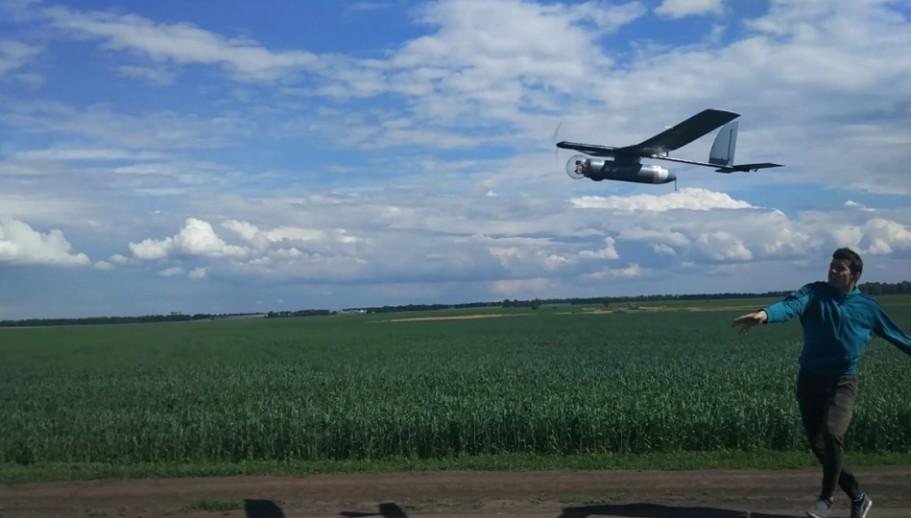
UAV Argus of the company "A.Drones" (http://adrones.com.ua/), hand-launched
Regarding service, the issue of using a non-original battery is solved quite simply, since there are fundamentally less requirements for observing their dimensions (and centering is not a problem). For such devices, the typical body material is aviation foam. Usually, to minimize the weight of the device, the device is calculated for the method of landing "on the fuselage", or, as they say, "on an airplane". Accordingly, the foam parts of the body, which perform the function of a shock absorber during landing, are expendable materials, on average they withstand about 200 cycles, depending on the pilot's qualifications and the type of soil. Although, with a certain dexterity, the case can be repaired on your own, or even cut a new one by hand or on a 3D milling machine - the material is not a problem. As an example of such a device, we can cite the PD1900 UAV, presented by the domestic company Drone.ua, with a flight duration of up to 100 minutes.
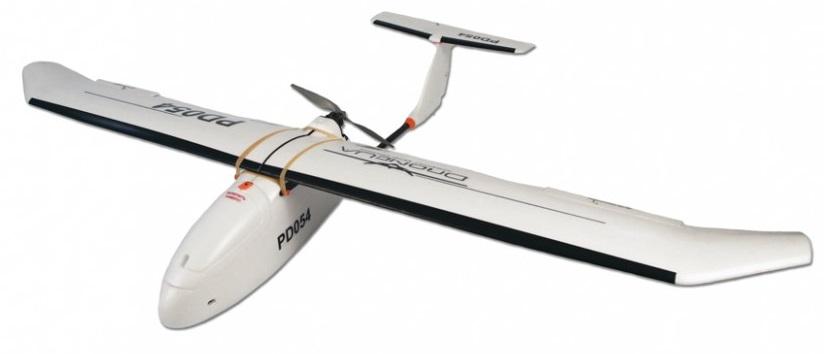
PD1900 UAV of the Drone.ua company (http://store.drone.ua/)
A typical way of taking off a UAV weighing more than 5 kg is to start from a layer - a catapult consisting of a strong rubber harness attached to one one end to the fuselage of the aircraft taking off, and the other to a pin fixed on the ground. The advantages of this method of starting are low weight and extreme simplicity of the necessary equipment. An alternative could be launch from a rigid catapult from a guide. Such a catapult is heavier than a layer, but allows you to launch much heavier devices.
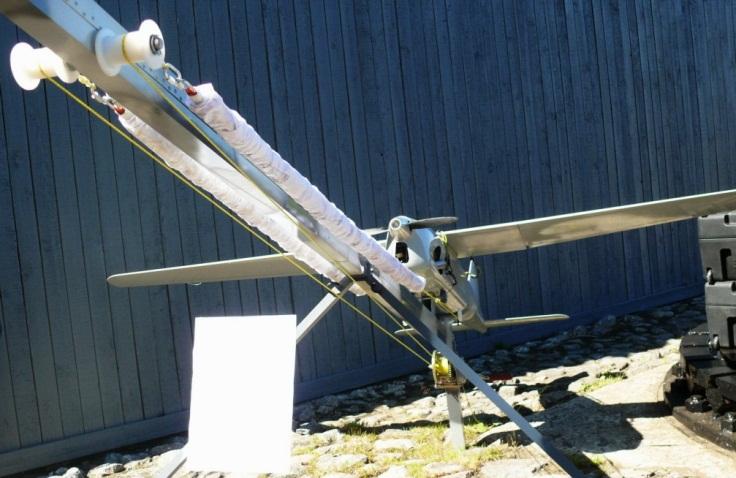
Orlan UAV catapult
The method of landing is parachute descent, which reduces the requirements for the operator's qualifications, but...
Most manufacturers of aircraft-type light UAVs recommend parachute descent as a landing method. This method is chosen partly due to the simplicity of its implementation, both from the technical side (the parachute is ejected at speed by a spring or pyromechanism from the device), and from the operator's qualification side - this method of landing only requires giving the command to release the parachute over the desired landing area.
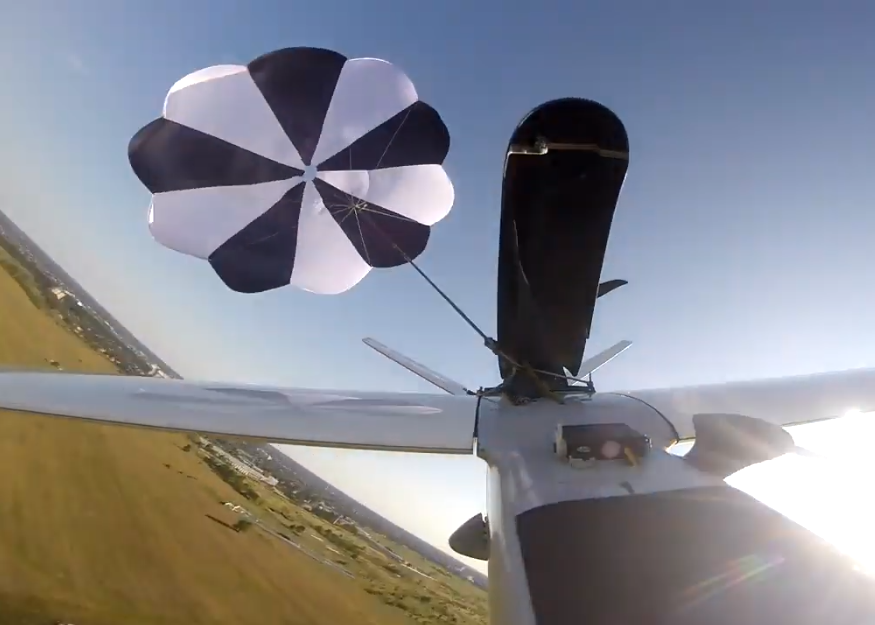
Photograph of the moment when the parachute leaves the UAV container for landing (https://smartdrones.ua/)
However, there are also significant disadvantages - the parachute takes up a significant amount of space in the hull, reduces the load capacity, parachute descent is uncontrollable and unpredictable in windy weather. In general, parachutes can be classified as high-tech consumables. The dynamic loads on this structure are high and the guaranteed number of trouble-free operations is insignificant. The repairability of these devices is limited and, as a rule, they are used as a lifeline in emergency situations: a corkscrew of the device, loss of control, etc. PARAZERO and M.A.R.S parachutes for UAVs are the most common on the Ukrainian market, the cost of which ranges from several thousand to tens of thousands of hryvnias. Therefore, at the choice of the operator, as a rule, unmanned aircraft are provided with the possibility of landing on the fuselage.
Modern materials for UAV gliders
For agricultural needs, the material of robotic aircraft is usually fiberglass and carbon fiber (composite material), due to their lightness and strength. The choice of composite materials is also due to the possibility of creating such a structure that would allow placing the payload inside the fuselage. This need is due to the fact that in most cases, the equipment installed on the UAV costs more, or the same, as the UAV itself. Therefore, the issue of equipment protection during takeoff/landing is very important. And the use of composite materials in the construction of light aircraft-type UAVs solves this problem. As an example, we can cite the DG FLIRT Arrow apparatus of the Ukrainian company ABRIS and the civilian multi-purpose version of the Spectator-M military unmanned light aircraft manufactured by the Ukrainian Meridian Joint-Stock Company named after S.P. Korolyova (Kyiv)
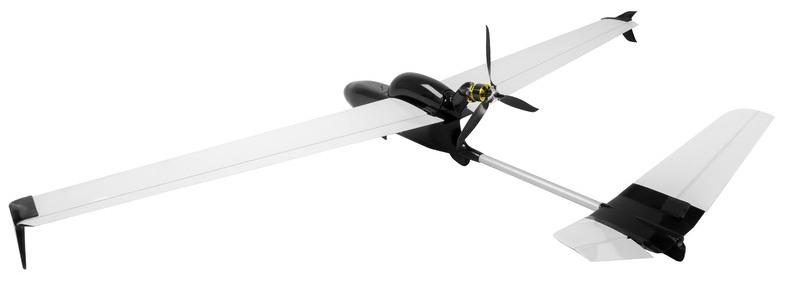
ABRIS DG FLIRT Arrow (https://abris.aero/)

Spectator-M UAV in flight (http://merydian.kiev.ua/)
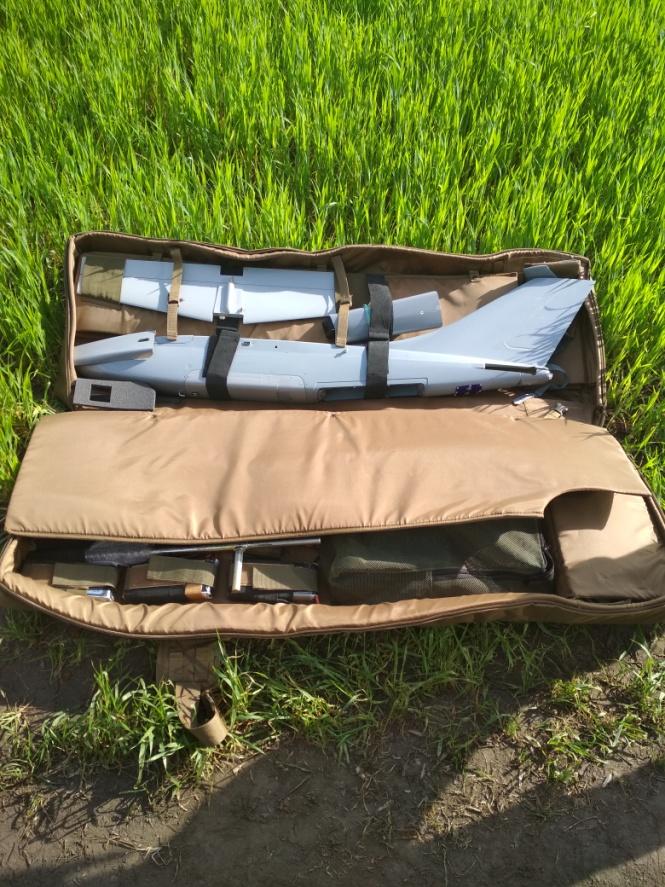
Spectator-M UAV in a portable case
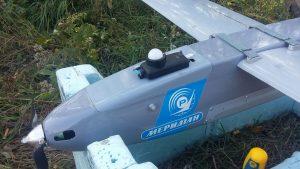
Spectator-M UAV with Slantrange spectral sensor equipment placed in the fuselage. Flight duration up to 3 hours (http://merydian.kiev.ua/). From above we can see the anti-aircraft sensor...
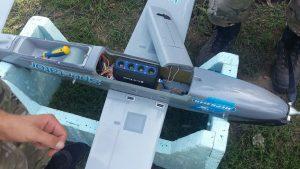
...and the channel sensors, which, of course, "look" downwards in flight
UAV with a flexible wing
The unmanned motorized hang glider is an apparatus based on a soft delta-shaped wing. Such a wing is three rigid guides connected to each other at the front point and forming a fan in the horizontal plane, with an angle between the pipes of 90-140 degrees. A strong fabric is stretched between the pipes. The two side guides and the back edge of the fabric form almost a triangle when viewed from above. The wing is attached to a cart on which a motor with a propeller (pulling or pushing) and equipment are mounted.
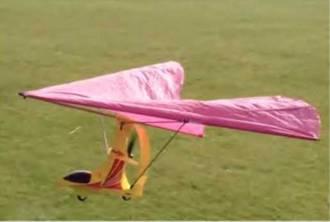
Unmanned hang glider
Flight control is usually carried out with the help of additional aerodynamic elements, a small deformation of the wing or with the help of a movable center of gravity. The speed of modern hang gliders ranges from 25 to 100-130 km/h, the flight height reaches 6 km or more. Due to the fact that a hang glider, unlike a paraglider, has a rigid wing that does not fold in turbulent conditions, they are more stable in the air and less susceptible to the effects of the external environment, in particular turbulence, which is always present in soaring flights. In addition, hang gliders fly faster, which increases the upper bar of wind speed limits. The advantage of the motorized hang glider compared to other UAVs is the simplicity and reliability of the design, cheapness and compactness in the folded state, noiselessness, lack of influence of vibrations from the rotor of the main rotor on the aerodynamic elements of the design. Disadvantages include relatively large weight and dimensions, as well as relatively long pre-flight preparation (from 20 minutes). In addition, there is a need, albeit a small one, for a take-off and landing site.
Therefore, aircraft solutions for organizing monitoring are organizationally and technologically suitable for implementation in production and provide an opportunity to provide farmers with operational information about the state of crops for crop management. Anyone who wishes will be able to choose a solution for himself, the range of tools allows, there are domestic localizations.
Beekeeper Natalya Anatoliivna ([email protected])