Perspectives for flying drones in crop production in Ukraine
The Internet is full of thematic sites about the use ofdrones in agriculture, unprecedented prospects, economy of everything and everything, avalanche-like growth of profits. At the same time, the interest of agrarians is extremely cautious. If a few years ago at agricultural exhibitions the sky was dark from various drones, in 2019 there were an order of magnitude fewer such demonstrations, which undoubtedly reflects the market trend. Did the use of this robotic technology not live up to the hopes of the producers? Let's try to understand the reasons, and there may be several of them:
- extremely insufficient methodological support for production;
- high price of devices, andespecially consumables for them:
- service services; to scale, taking into account our realities. In China, which, thanks to the company DJI, occupies a leading position in the world market of drones, a state program for the development of unmanned technologies and the introduction of flying robots in agriculture has been developed. Similar approaches in the USA. Ukraine has its own regulations on the development and implementation of unmanned technologies, and, we believe, will form its own program for the development of these highly effective innovative technologies in a variety of industries, and in agriculture, various drones will become a familiar tool that performs a variety of tasks.
- конфиденциальность данных.
Зарубежный опыт использования дронов
Зарубежный опыт триумфального шествия дронов трудно масштабировать, с учетом наших реалий. В Китае, который благодаря компании DJI занимает лидирующие позиции на мировом рынке дронов, разработана государственная программа развития беспилотных технологий и внедрения летающих роботов в сельском хозяйстве. Аналогичные подходы в США. Украина имеет свои регламенты в вопросах развития и внедрения беспилотных технологий, и, на наше убеждение, сформирует свою программу развития этих высокоэффективных инновационных технологий в самых разных отраслях, а в сельском хозяйстве различные беспилотники станут привычным средством, выполняющим самые разные задачи.
Drones as a component of precision agriculture technologies
A global trend in crop production is recognizedprecision technologies agriculture, which provide for a differentiated approach within one field, which significantly increases the biological and economic efficiency of technological methods, first of all, the use offertilizers and means of protection. The times of the USSR, when fertilizers were cheap, affordable, supplied to even the most remote farms under the state program, have passed irrevocably, and the question of their rational application has become extremely urgent. Now there is a trend of growth in the cost of plant production, namely mineral fertilizers. The involvement of farms in the cultivation of fodder grain, which is less demanding of fertilizers, is also very risky, taking into account the reduction in the number of livestock in the country.
In technologically developed countries, the problem of optimal use of fertilizers was understood long ago and systems of differentiated application were developed for ground equipment based on methods of spectral assessments of plant condition. The most famous ones include GreenSeeker from Trimble Agriculture (USA), CropSpec from the Japanese company Topcon Positioning Systems, and N-sensor from Yara International from Norway. Such equipment made it possible to reduce the cost of fertilizer, obtain a higher quality harvest and contribute to the improvement of the ecological situation.
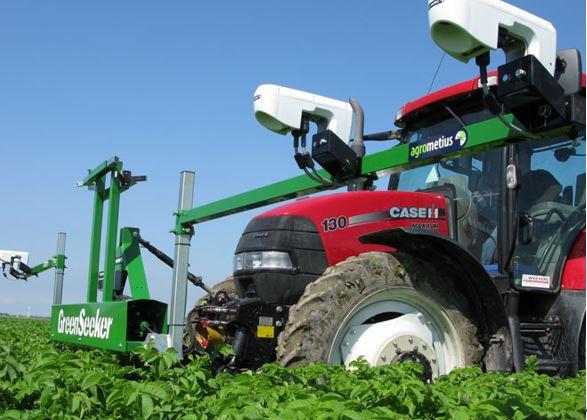
The GreenSeeker system (photo from Trimble Agriculture website https://agriculture.trimble.com)
However, mass implementation of such equipment did not happen in our country for a number of reasons:
- high price - the Greenseeker kit costs about UAH 117,000; in addition, when borrowing the entire technological chain (seeds, equipment, agrochemistry, etc.), - the main profit is received by the supplier of technologies, not the owner of the agricultural enterprise; the technique in Europe and the USA has been used for many years, and there are such dependencies, but they are created for their typical varieties and hybrids; for our varieties, adaptation of similar technologies is required; trade wars have become the realities of modern times, and there is a real possibility of falling under one or another sanctions with restrictions on the supply of equipment or its components.
- это оборудование создано для реализации устаревшего критерия оптимальности – максимальный урожай, тогда как более предпочтительна для хозяйств максимальная прибыль;
- недостаточное экспертное сопровождение, - для применения системы нужны калибровочные зависимости спектральных показателей растений от количества азота; техника в Европе и США применяется не первый год, и такие зависимости есть, но они созданы для их типовых сортов и гибридов; для наших сортов требуется адаптация подобных технологий;
- доступность на рынке, - это новая тенденция, которая может о себе очень громко заявить в обозримой перспективе; торговые войны стали реалиями современности, и есть реальная возможность попасть под те или иные санкции с ограничением поставок оборудования или его компонентов.
В этих условиях дроны имеют неплохие перспективы внедрения в аграрные практики именно в нашей стране.
Let's list the obvious components of these prospects:- The high resolving power of spectral systems forUAVs makes it possible to obtain detailed maps of vegetation indices, suitable for planning operations. Modern drones are capable of surveying up to 10,000 hectares per day, so you need to buy a limited number of systems or order a flight from third-party organizations. Today, when ordering 1,000 hectares, the cost of ready-made maps is about UAH 35/hectare. Modern equipment allows you to get ready-made maps after the landing of the drone;
- If there is information about the real condition of the entire field, it is possible to take into account the trends of the grain market and achieve maximum profitability. In addition, when using drones for remote sensing, it is possible not to buy newequipment for applying lateral mixes, but to modernize the existing one, equipping it withpositioning systems (GPS, Galileo, Glonass). In other words, thanks to drones, the technological capabilities of the equipment of the next generation can be obtained;
- For varieties of crops for which spectral calibration characteristics are not provided, it is possible to establish small experimental plots with different modes of mineral nutrition. This will make it possible to decide on the optimal dosage of fertilizer on the spot after the flight. At the same time, there will be no binding to specific producersagrochemicals;
- Drones and especially their spectral sensors belong to high-tech robotic equipment, but their dimensions and mass are relatively small for various delivery methods... In addition, part of the equipment specification already has a local localization.
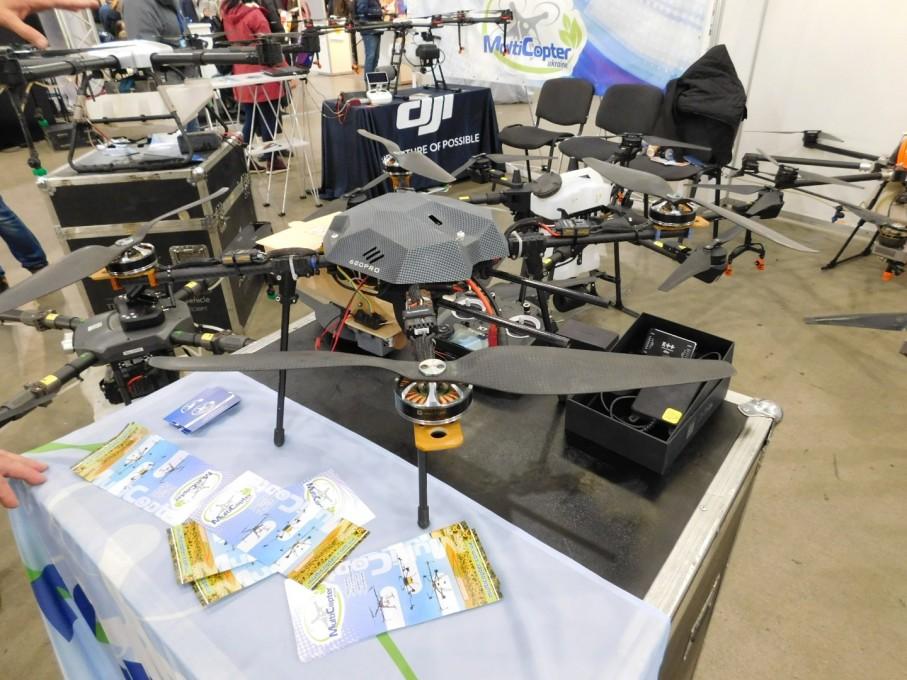
There is always increased interest in drones at agricultural exhibitions, as well as in relatively small ones whose task is monitoring...
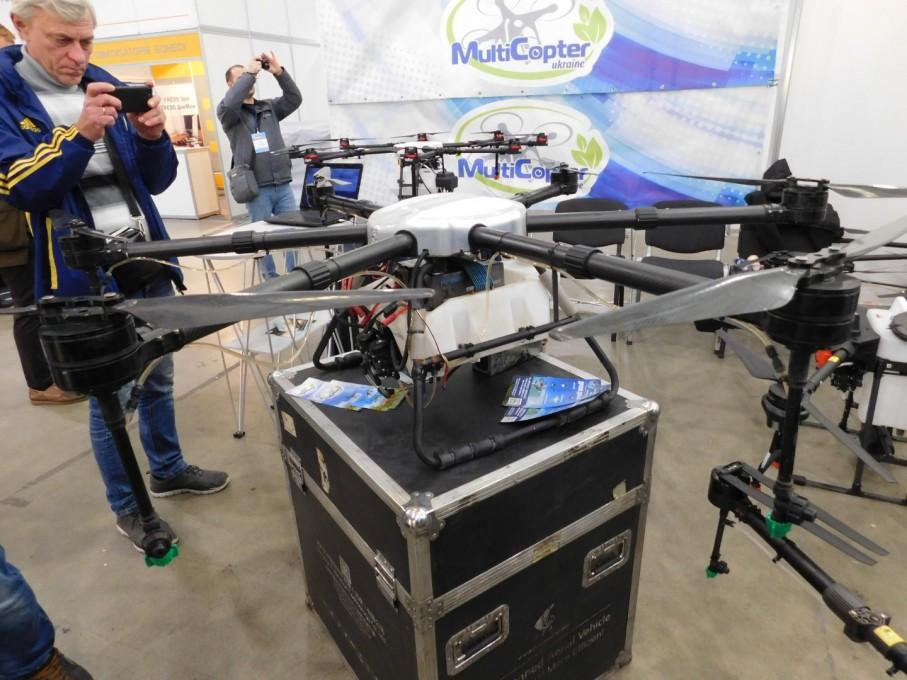
...and big, already functional...
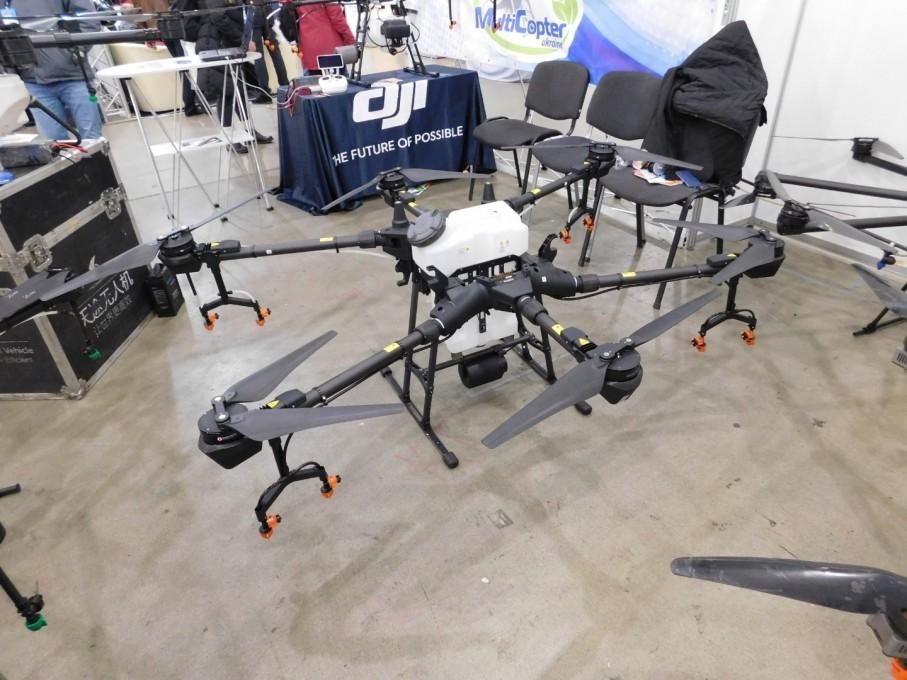
...and very big...
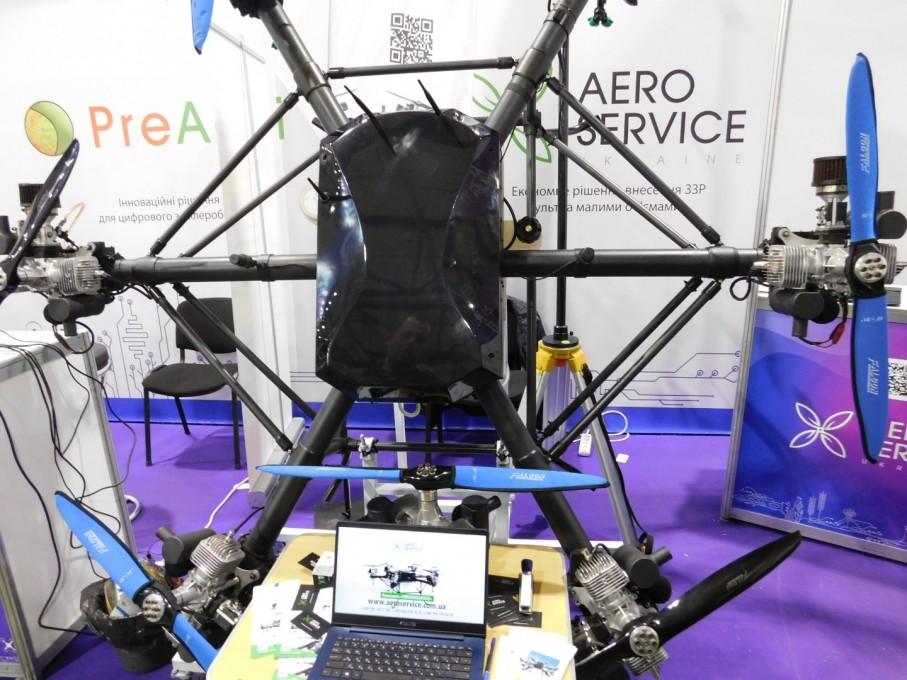
...or even with internal combustion engine
In this way, we are confident in good prospects for crop production of thisinnovative equipment.
Opryshko Aleksey Aleksandrovych ([email protected]);
Pasychnyk Natalya Anatolyevna ([email protected])