About the innovative portable soil analyzer SoilCares
The market of devices for precision agriculture is one of the most promising for startups, and therefore new measuring devices appear periodically. Unfortunately, for the user, the general description of these gadgets can be described as "super mega innovative, a prototype of a magic wand, when you buy it, happiness comes the next day." With such descriptions, it is quite difficult for manufacturers who hear it all the time and have already gotten burned, to make a decision on the introduction of such innovations. Therefore, in this article we will try to describe our vision of samples of new equipment from the point of view of a developer who has encountered these technologies.
Standard chemical analyzes in agrochemistry are tied to the laboratory. These are analytical definitions that require specialized laboratories, qualified personnel, appropriate equipment, chemical reagents, dishes, etc. To this we add the logistics of delivering samples from the field, the duration of the analysis - as a result, you understand that it is expensive and time-consuming. But it should be noted that only laboratory analysis is the most objective for practical purposes and indispensable for research.
But the promptness of obtaining results for making technological decisions, the simplicity of performing soil studies reasonably attracts practitioners, and mobile devices that allow rapid analysis will be in demand.The Dutch company AgroCares presented its product – the soil scanner SoilCares Scanner, which, according to the characteristics declared by the developer, should show:
- pH (KCl); уровен);
- Органическое вещество, % органического углерода;
- Гранулометрический состав, % глины;
- ЕКО (емкость катионного обмена), ммоль+/кг;
- Температура грунта, °C;
- Общий азот (низкий, средний или высокий уровень);
- Общий фосфор (низкий, средний или высокий уровень);
- Total potassium (low, medium or high уровен).
The algorithm for obtaining and transforming data, as a rule, is not given due to the "strictest commercial secret". Let's try to figure out what it is about. We do not consider temperature, electrical conductivity, soil pH and other traditional parameters for mobile devices, limiting ourselves to breakthrough results for mobile equipment, namely organic matter and nitrogen.
So, organics
The question of the organic matter of the soil is extremely relevant, as it reflects its state. Control of the content and composition of organic matter should be carried out by the soil user, but most importantly by the state service. The training of a controller and an agronomist will be different, since the controller will initially be mostly prepared for conflicts of interest with people in various manifestations. Accordingly, employees of the monitoring services will need mobile devices for express assessment of soil conditions, at least in the indication mode. This would significantly simplify the system of monitoring and control of the soil condition, would help to determine the areas of priority laboratory inspection, would contribute to the efficiency of measures to preserve and restore fertility.
A team of researchers under the leadership of academician S. Yu. Bulygin at the National University of Bioresources and Nature Management of Ukraine was engaged in such tasks, and proposed to implement spectral-visual soil diagnostics into practice.
Experienced soil scientists, agrochemists can determine the content of organic matter, what is called, "by eye". According to S.Yu. Bulygin's story, in the Soviet years, he encountered an interesting fact in an agrochemical laboratory. A certain lady worked in the laboratory, who apparently "got" the management to such an extent that they decided to "fire her by article." In the years of the USSR, such an entry in the labor book was something exceptional and closed many paths in life, therefore it was simply not used. In fact, the management knows that the analyzes of the content of organic matter in the soil are falsified, since the employee in the laboratory definitely did not do them and appoints control measurements in order to bring her to "clean water". The analyzes are carried out in strict accordance with the regulatory documents, since we expect a conflict of interests, but when compared with the data taken by the employee, it turns out that the available discrepancies are within the limits of tolerance... That is, without doing analyzes, she obtained adequate results in terms of the appearance of the samples. How the story with the employee ended is not important, but the idea of productive visual diagnostics was noted.
Hence, if the human eye can do it, then probably a digital camera can too. It is not necessary to wait for the film to appear and the analysis can be really operational. The scheme was implemented simply: the examined soil sample in a superficially dry state was sieved through a specific sieve onto a sheet of paper and the intensity of the color components of the sample was measured. To take into account the level of illumination, a sheet of paper itself was used as a reflector panel. Studies were conducted to select the optimal color of the optical standard, which could be produced on an ordinary laser printer (in grayscale).
The idea was practically implemented in the Land Damage Expert program.

Implementation of soil analysis in the optical range in the Land Damage Expert program
When working, the expert had to select the type and subtype of the soil to use one or another calibration dependence that was obtained by traditional research methods. The method of obtaining this calibration curve was quite simple: pits were dug and samples were taken from different depths - samples with different amounts of organic matter (humus) were obtained.
If it is possible in the optical range, then it is quite likely possible to do it in the near infrared used by SoilCares.
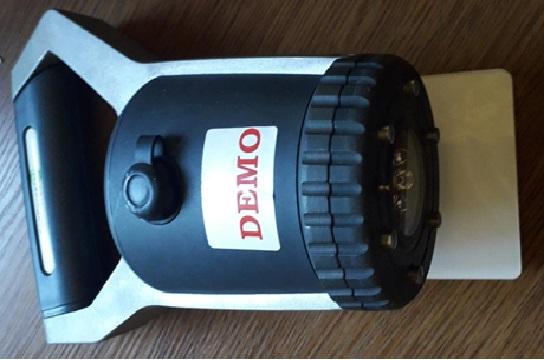
SoilCares Scanner soil scanner of the Dutch company AgroCares
Infrared LEDs are visible in the photo, which illuminate the sample under study. When working, there will be no external uncontrolled lighting, so the technology is simplified. There are many collections of soil samples in our country, although there are about 300 soil types and subtypes, the task is in principle feasible. Maps of soil types also exist, they are stable, and thanks to the built-in GPS module in the device, choosing the necessary calibration dependence is not a problem. In other words, the task is in principle realized and the possible principle is clear.
Total nitrogen
In the description of the system it is stated that soil analysis is carried out for total nitrogen (three gradations low, medium and high), although classical agrochemical methods are designed for mineral nitrogen, which the plant can actually absorb. But, lest we enter into a conflict of scientific schools, we will consider this question to be debatable, perhaps there may be some correlation between "common" and "mineral" nitrogen. In other words, if the data of experimental measurements are reproducible, then the possibility of obtaining nitrogen information within 2 hours would be interesting for producers. The choice and justification of fertilizer dosage at the very initial stages of plant development is very simplified.
But how it is done, on what physical principles, the question is quite interesting, since there are no mobile analogues. It is necessary to understand that any technology or device proposed for practice must undergo testing, which is carried out by disinterested specialists or organizations. Advertising materials for the device indicate that the device is "actively used" in Kenya, Tanzania, and Ivory Coast, but the agricultural scientific schools of these African countries, from the authors' point of view, are hardly among the most famous and authoritative in the scientific world. In the international full-text search service for scientific articleshttps://www.sciencedirect.com/ this device was mentioned in three articles, which cannot be called an outstanding result. For example, a specialized sensor for field monitoring using Parrot sequoia drones was mentioned more than a hundred times. In the Russian analoguehttps://cyberleninka.ru/ and the catalogs of the Central Agricultural Library of the Russian Federationwww.cnshb.ru the term SoilCares was not mentioned as of 07/05/2020.Since we did not find data from independent domestic sources, thanks to the availability of the device, we will try to conduct research in practice on the basis of the laboratories of the Department of "Agrochemistry and Plant Production Quality" of NUBiP of Ukraine. We will share the results obtained in the continuation of this article.
Pasychnyk Natalya Anatolyevna ([email protected])