We are building a film greenhouse, or they are also called spring...
Filmgreenhouses, or they are also called spring. Such greenhouses do not require complex calculations of wind and snow loads and are very popular in households. They allow some "liberties" during construction - the frame can be made even by a non-specialist, after which it can be covered withfilm. But at the same time get the planned benefit.
The first thing that is paid attention to when evaluating a greenhouse is the shape of the roof. It should be in the form of an arch or with slopes. You can make a tent-shaped or single-sloped roof.
A flat roof for a greenhouse is taboo!
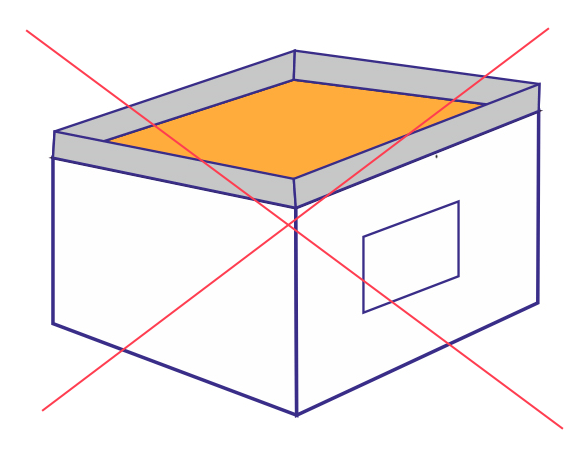
In no case is it recommended to make it flat (parallel to the floor level), water will not run off or snow will fall from such a roof!
Another disadvantage of such a roof is that according to the laws of physics, warm air collects in the lower part, and cool air collects in the lower part. And if the shape of a semicircle or with slopes allows its circulation, then the flattened one does not. Therefore, the shape of the roof is the first thing to start with when choosing a project or construction scheme.
2-slope construction
2-slope construction requires setting the slope angle (at least 230). Such are done in many houses. It is not necessary to look for craftsmen from the construction of the roof, it is quite possible to do it yourself. To make a frame, you need to put the columns at the same level and height, connect them to each other in the upper and lower parts, and every 3-4 - diagonally, like the first and second on each side.
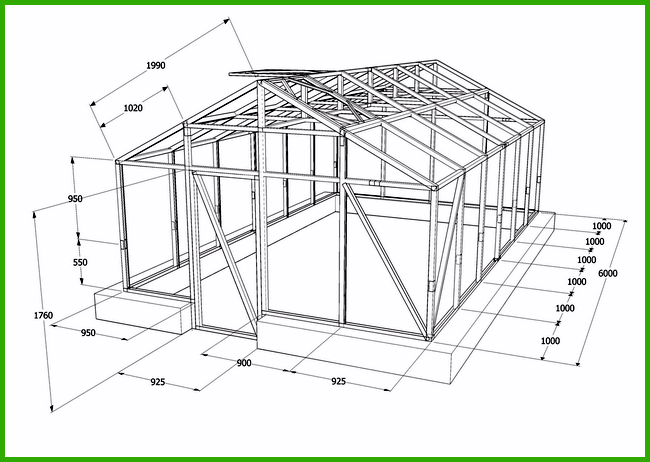
2- sloping form of the roof of the greenhouse. Typical structural dimensions. If suitable lumber is available, making such a frame is a matter of one weekend.
The connected columns in the upper part form the basis of the roof - Mauerlat. The rafters are connected from below with so-called pulls, forming a triangle. For the rigidity of the structure, you need to connect the rafters in the transverse direction every 100 cm. These elements are called purlins or trusses. The second disadvantage of such greenhouses is that it is necessary to provide places that open for ventilation (greenhouse transoms). In industrial greenhouses, the comb is opened from both ends.
From the point of view of fixing the film, wood is the best material due to its low thermal conductivity (the film does not melt when in contact with wood) and the ease of fixing with strips. However, it cracks over time, it begins to "lead", which leads to distortions. Condensation often collects under the film, which in the places of contact with the elements of the wooden frame leads to their decay (therefore, it is advisable to treat the wood with antiseptics for external use, resistant to washing and neutral to the film), destruction by solar ultraviolet light. Therefore, this material is found only for small and medium-sized greenhouses. The use of a metal frame is more common. Often a wooden beam is attached to the metal (but the problem with condensate also remains, so let's process it!), to which it is convenient to nail the slats with the fixing of the film and avoid the contact of the film with the metal.
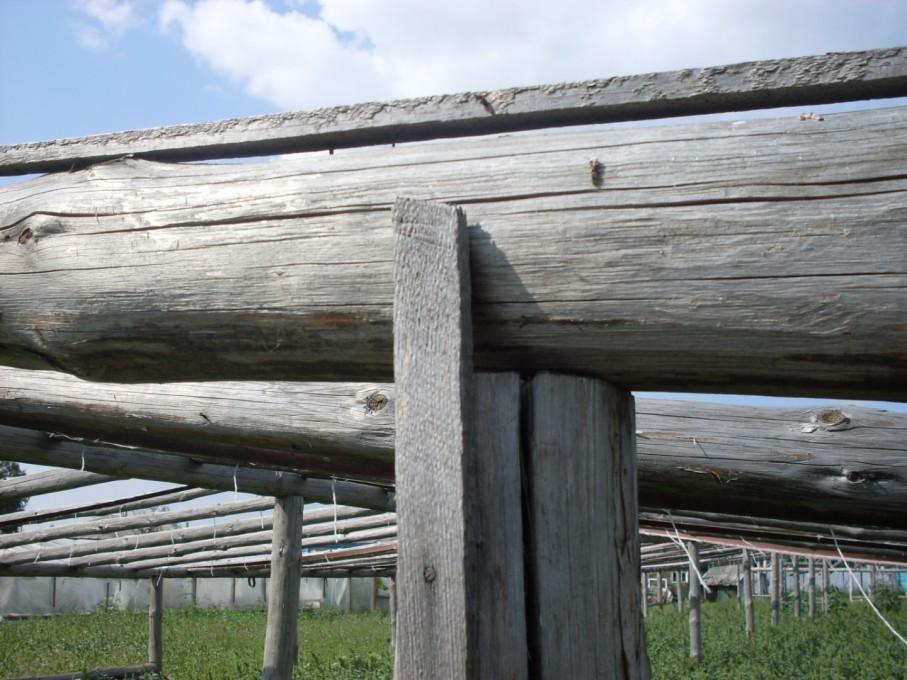
The disadvantage of the wooden frame is that it cracks over time, it "leads", it is destroyed under the influence of solar ultraviolet light and insects, condensation under the film.
The third disadvantage of 2-slope greenhouses is a greater consumption of film, compared to an arched structure (slopes, unlike semicircles, take more length). Because of these disadvantages, greenhouses of this shape are less common than arched greenhouses.
Аркові теплиці
The arched greenhouses got their name from the roof, which has a semicircular shape. For the construction of the frame, you will need to bend the pipes to a certain radius.
The width of the greenhouse in terms of mechanization should be at least 6 m. it will be impossible to drive in with a tractor. Most often, it is given in 10-11 m - otherwise you will have to put the height of the greenhouse - so that you can drive in with a dump truck. The radius can be considered as the height of one arch L=2×3.14×4 = 25.12 m. The arch is half a circle, so 25.12/2 = 12.6 m. This is the length with the addition of 40 cm for burying on both sides (it will be 13.4 m). The standard distance between the arches is also 3 m.
Knowing the length of the greenhouse, calculate the required number of profile pipes should be placed at the same level and height. They are connected across each other at the highest point, on both sides of which are also connected with 2 rows of pipes (trusses). This is a standard construction of spring greenhouses.
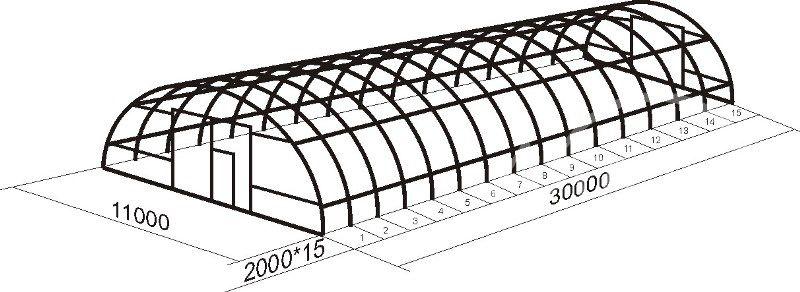
Arched greenhouse (industrial size) - from both edges from the upper point, each of the arches is connected by 2 rows of pipes. This is a standard construction of spring greenhouses. If their number is increased, it unnecessarily increases the metal capacity of the frame.

For the rigidity of the frame, the arch is attached to the end elements on all sides of the greenhouse
It is not advisable to give a height of more than 3.5-4 m - it is quite enough for the passage of machinery when it is necessary to bring in humus (chernozem) or drive by tractor. The higher the greenhouse, the greater the volume of air under it, and therefore the greater the costs of heating it. It is clear that it is much more difficult to bend arches out of wood, so always arched greenhouses with a metal frame. They also need to provide for the possibility of ventilation. Transoms in them are usually made from the ends, opening part of the first and last arches.
In order to bend the pipe and give it the shape of an arch, a pipe bender is used.
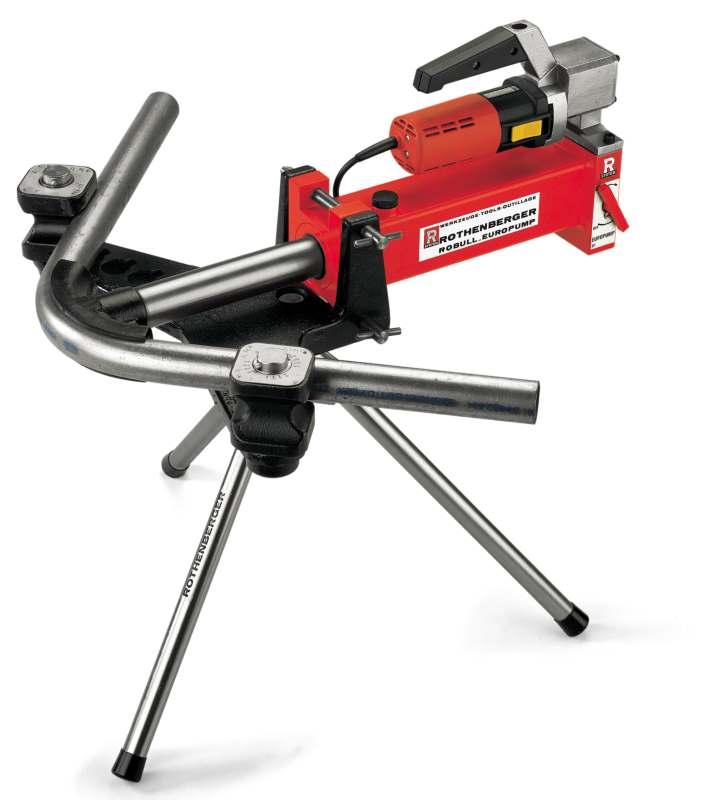
An example of a pipe bender with an electric drive
This device is used by organizations that provide services for the construction of metal structures. It is almost impossible to bend a large number of pipes to the required radius at home. Because of this, you will have to order the installation of arches on site. Pipes are delivered already bent, and then welded together on the spot, buried and exposed at the same height and level. It is possible to order a frame with a double film. The cost of the frame of such greenhouses is on average about 500 hryvnias/m.2. That is, for the construction of a greenhouse measuring 10x50 m, you will have to spend 200-250 thousand hryvnias. In them, an air layer of 10-15 cm is formed between the film.
It is possible to pump warm air into it, which makes it possible to start operation of such greenhouses already in January-February. The cost of the air injection system and the heating boiler are not included in the cost of the frame. It is better to choose a galvanized pipe according to the DIN17455 or ANSI304 standard. Arches made of such a pipe can withstand a wind load of up to 100 kg/m.2.
In any case, galvanized pipes are best. Black metal pipes are three times cheaper, but they corrode faster. To protect against it, the frame should be painted with a high-quality 2-in-1 or 3-in-1 paint (together with a metal primer and a rust converter). If you apply it qualitatively in 2-3 layers and dry it well, it will last 7-8 years. But these are also additional costs for paint and painting.
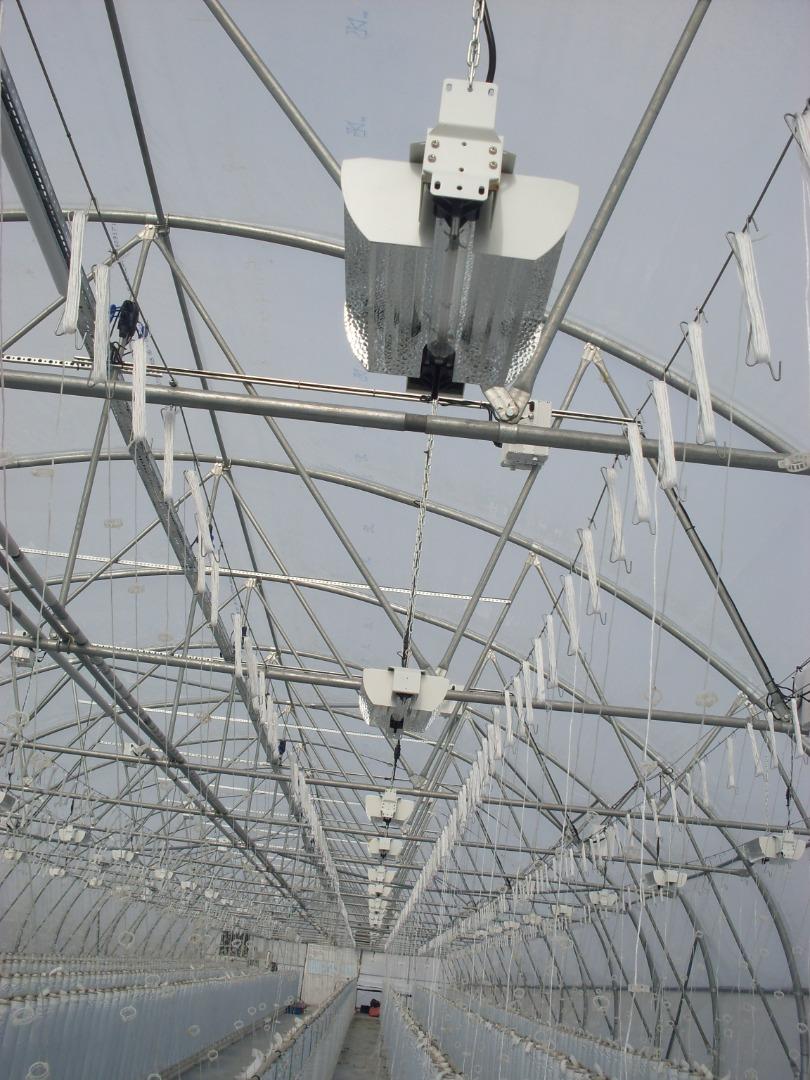
The galvanized frame is fashionable. Although it is three times more expensive than ferrous metal, it is much more resistant to corrosion.
Rebars can be welded to the welded crossbars under the arches, which will be a trellis to which the upper end of the twine is tied. But you can also stretch a wire with a diameter of 4-5 mm.
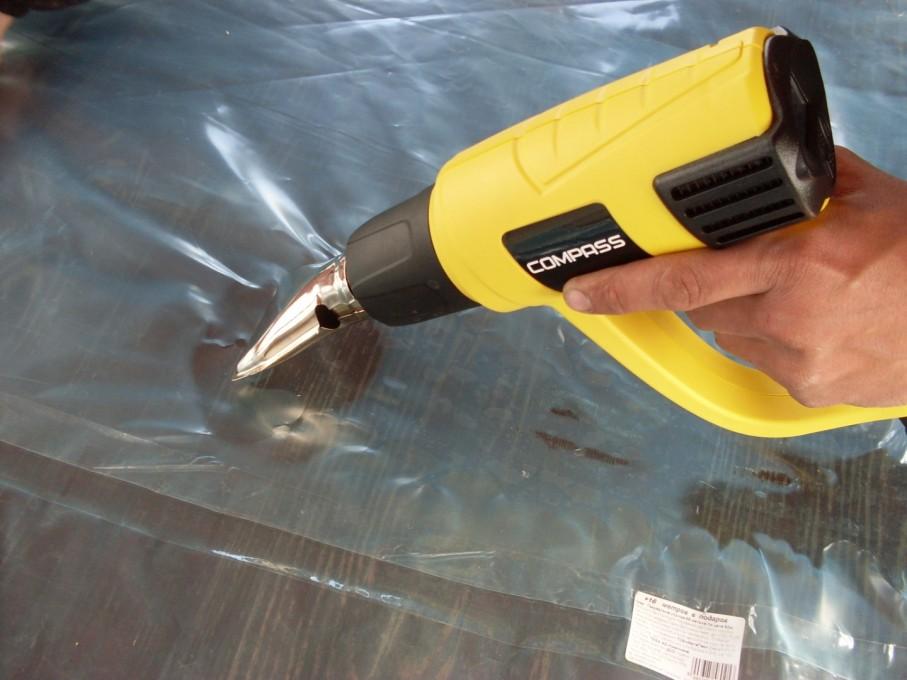
The method of welding with a technical hair dryer is more efficient than with an iron, but not professional.
A film is thrown over the frame, leaving an overlap of 50-70 cm at the edges. Previously, these edges of the film were buried to the ground. And although this provided protection from being blown off by the wind, when removing it for the winter, the dirty edges of the film contaminated the entire roll. Because of this, it is now practiced to install a U-shaped profile to the lower part of the arches (sometimes below the ground level). Like plasterboard, to which a film is wound and fixed with zigzag springs.
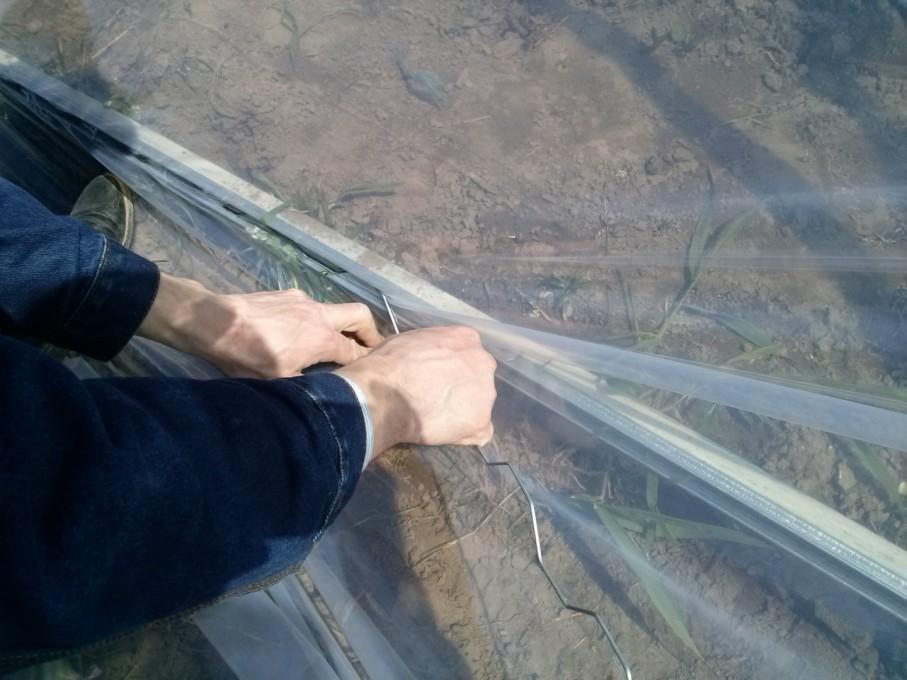
U-shaped profile is an alternative to covering the edges of the film with soil. The film remains clean for him.
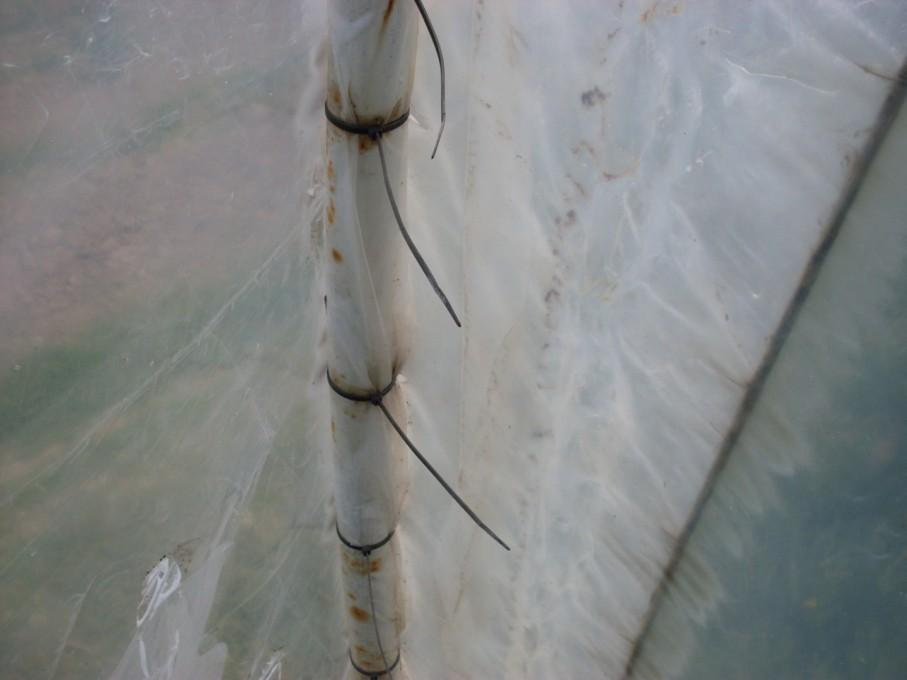
It is especially difficult to fix the edges of the film on the first and last of the arches. They are wrapped around the pipe and fixed with plastic ties.
The interfilm layer of air creates the effect of an "air cushion", allowing to reduce heat loss, especially together with the system of injecting warm air into the interfilm space. This system works from a radial fan, which through special flanges (insets) injects air between the layers of the film with the help of special corrugated pipes. Air intake takes place from the upper inner part of the greenhouse.
On the perimeter of doors and transoms, you need to fasten a strip for installing a seal, which also reduces heat loss. For wind protection, holes can be drilled in the lower part of the arches, into which metal O-shaped elements can be inserted. Twine with a diameter of at least 1 cm is tied to them (so that it does not cut into the film), which is thrown diagonally, tying to another arch from the other edge of the greenhouse, into which similar O-shaped elements are also inserted.
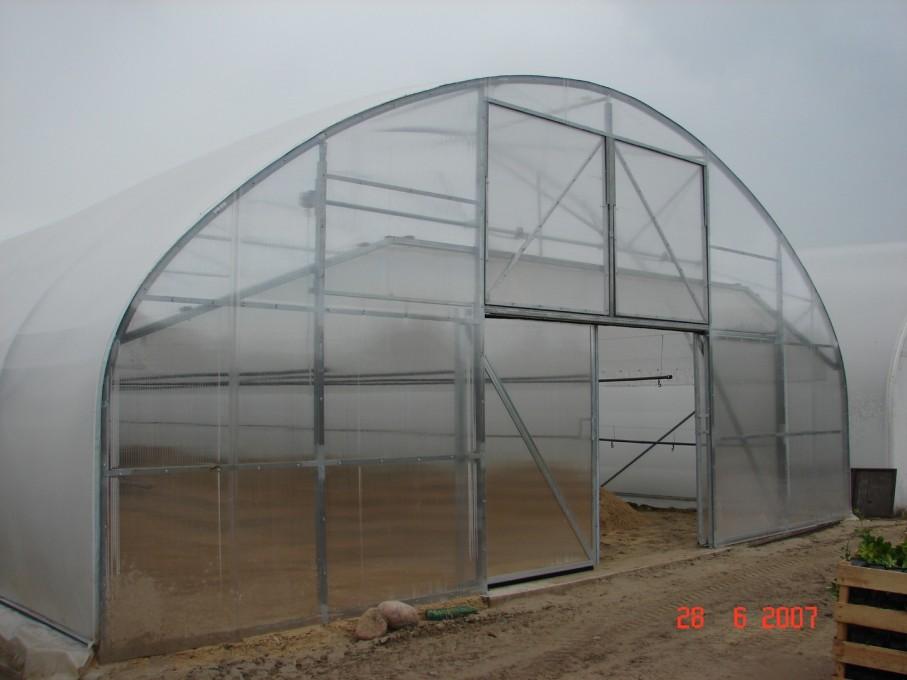
Arch greenhouses are popular, in which the arches are raised on posts. This allows you to work the soil near the edges. For maximum mechanization, the arrival of tractors and dump trucks is provided.
It should be said that the disadvantage of such arched greenhouses is the uneven height in the center and at the edges. Therefore, cars and tractors will not be able to work near the edges (at a distance of 2 m). And the plants on the edges will not be able to grow, as closer to the middle. Because of this, greenhouses in which the arches are raised on posts are becoming popular nowadays.
And what types of greenhouse films are, we will consider in the article"Greenhouse film", and how to choose and buy a film - in the section"Greenhouse film"