For sale / buy
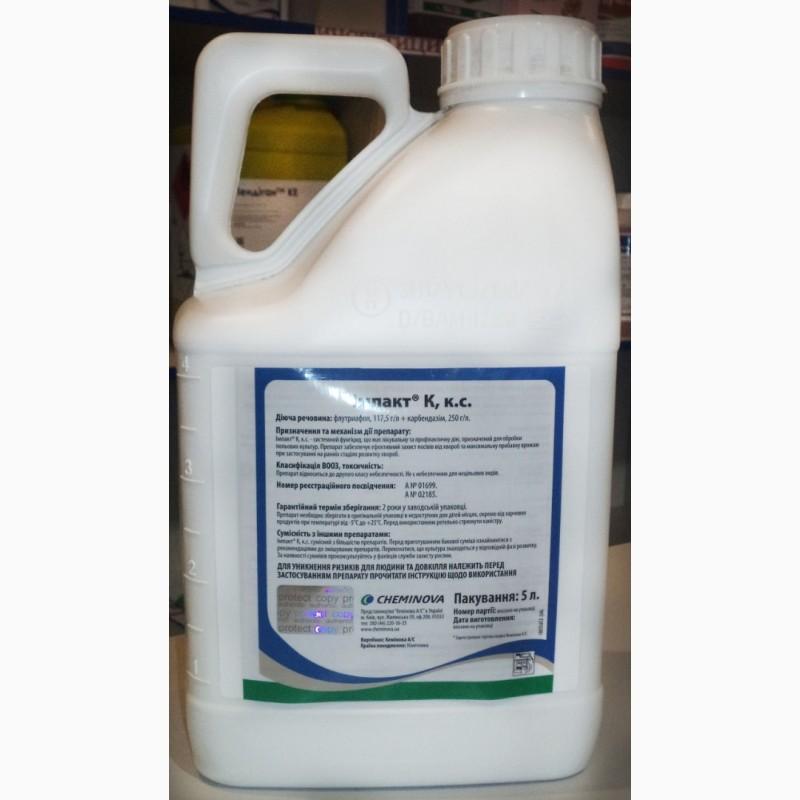
Fungicide impact k, Kyiv
Price380 UAH.
Region:all Ukraine,
Kyiv
Updated:
Fungicide Impact is a systemic fungicide for cereals,grapes and beets.
Technical information:
The active substance of Impact fungicide — flutriafol belongs to the class of triazoles. Flutriafol has pronounced systemic properties, and this provides a number of advantages compared to other fungicides.
Fungicide Impact is used for treatments on vegetative plants. After spraying, flutriafol quickly penetrates the leaves of plants and spreads throughout the plant.
Impact
Brown rust (Puccinia recondita)
Yellow rust (Puccinia striiformis)
Stem rust (Puccinia graminis)
Septoriosis (Septoria spp. )
Fusarium head blight (Fusarium spp.)
Helminthosporioza (Helminthosporium spp.), including
reticulate spot (Drechslera teres) and dark brown spot (Bipolaris sorokiniana = Helminthosporium sativum)
Powdery mildew (Blumeria (Erysiphe) graminis)(//tractor-service.com)
Yellow spotting or pyrenophorosis (Pyrenophora spp. )
Rhynchosporiosis (Rhynchosporium spp. )
Therapeutic (curative) action
Cereals, treated with Impact fungicide before the appearance of disease symptoms, were effectively protected against leaf septoria (Septoria tritici) for 28 days.
The active substance flutriafol completely eradicates yellow rust (Puccinia striiformis). Addition of morpholine to Impact fungicide strengthens its action against yellow rust.
Protective (prophylactic) action:
The maximum containment of pathogenic infection occurs if timely processing of crops was carried out before the disease developed. Impact has very good protective properties.
A feature of Impact fungicide is its excellent action against rust species (P. striiformis and P. recondita). The action of Impact against rust is clearly visible on the graph, the protective action continues for 42 days after treatment. If the treatment is carried out before the disease manifests itself, the duration of action of the Impact fungicide can be 6-8 weeks, sometimes longer.
Consumption rate
Spring and winter wheat, spring and winter barley, rye, rapeseed — 0.5 l per 1 ha.
sugar beet — 0.25 l per 1 ha.
Grapes — 0.1 l per 1 ha.
Apple tree - 0.1-0.15 l per 1 ha.
Technical information:
The active substance of Impact fungicide — flutriafol belongs to the class of triazoles. Flutriafol has pronounced systemic properties, and this provides a number of advantages compared to other fungicides.
Fungicide Impact is used for treatments on vegetative plants. After spraying, flutriafol quickly penetrates the leaves of plants and spreads throughout the plant.
Impact
Brown rust (Puccinia recondita)
Yellow rust (Puccinia striiformis)
Stem rust (Puccinia graminis)
Septoriosis (Septoria spp. )
Fusarium head blight (Fusarium spp.)
Helminthosporioza (Helminthosporium spp.), including
reticulate spot (Drechslera teres) and dark brown spot (Bipolaris sorokiniana = Helminthosporium sativum)
Powdery mildew (Blumeria (Erysiphe) graminis)(//tractor-service.com)
Yellow spotting or pyrenophorosis (Pyrenophora spp. )
Rhynchosporiosis (Rhynchosporium spp. )
Therapeutic (curative) action
Cereals, treated with Impact fungicide before the appearance of disease symptoms, were effectively protected against leaf septoria (Septoria tritici) for 28 days.
The active substance flutriafol completely eradicates yellow rust (Puccinia striiformis). Addition of morpholine to Impact fungicide strengthens its action against yellow rust.
Protective (prophylactic) action:
The maximum containment of pathogenic infection occurs if timely processing of crops was carried out before the disease developed. Impact has very good protective properties.
A feature of Impact fungicide is its excellent action against rust species (P. striiformis and P. recondita). The action of Impact against rust is clearly visible on the graph, the protective action continues for 42 days after treatment. If the treatment is carried out before the disease manifests itself, the duration of action of the Impact fungicide can be 6-8 weeks, sometimes longer.
Consumption rate
Spring and winter wheat, spring and winter barley, rye, rapeseed — 0.5 l per 1 ha.
sugar beet — 0.25 l per 1 ha.
Grapes — 0.1 l per 1 ha.
Apple tree - 0.1-0.15 l per 1 ha.
|
Author, contacts | |
Denys / отзывы, инфо. / evaluation activities | |
|
Telephone:
0955xxxxxx
show
| |
All user ads ~31 | |
Ad ID: #717979
(added by a registered user, registration date: 27-07-2017)
Added/Updated: 09-21-2026 10:36 (relevant, until: 09-21-2027)
Permanent ad address:
Showed / watched for today: ?, total: ?
Similar ads
Among them there are many interesting ones...