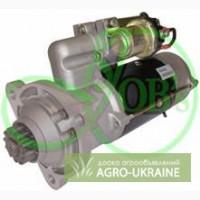
/ Agricultural machinery, equipment, inventory / Spare parts for agricultural machinery / Spare parts for harvesting agricultural machinery / Spare parts for combines / Starter combine harvester ST-100

Sell / buy
Starter ST-100 combine, Kyiv
Region:
Kyiv
Startercombine "NIVA" ST-100
Purpose and device
(//tractor-service.com)
The starter is designed to start the car engine. It consists of three main parts: a direct current electric motor, a retracting relay and a drive gear with an overrunning clutch.
Electric motors are used with electromagnetic excitation or disturbance from permanent magnets. The latter are more modern. They are more compact, simpler, consume less current and have a high rotation speed, but less torque. Therefore, in the design of such starters, a reducer is additionally introduced to increase the torque. The reducer is planetary, consisting of three gears rotating around the central gear. The design of the electric motor includes a rotor (rotating part) and a stator (stationary part). Power is supplied to the rotor using sliding spring-loaded contacts - brushes. The current consumed by the starter during operation is in the range of 100-200 amperes, and when starting in frost it can reach 400-500 amperes. That is why it is not recommended to keep the starter on for more than 10-15 seconds.
The retractable relay is designed to supply power to the electric motor and drive the drive gear to the flywheel crown. When the ignition key is turned to the "Start" position, power is supplied to the relay contacts. At the same time, the power circuit of the electric motor is closed, and the relay armature engages the gear with the flywheel crown through the drive lever. In more modern starters, the pull-in relay has, in addition to the main winding, also a holding one. This additional winding is designed to reduce the current consumed by the starter, since much less current is required to keep the relay in the on state than to start it.
The overtaking clutch ("bendix") protects the electric starter motor from damage after starting the engine. As soon as the rotation frequency of the crankshaft exceeds the rotation frequency of the starter, the overtaking clutch disconnects the drive gear and the electric motor shaft.
Purpose and device
(//tractor-service.com)
The starter is designed to start the car engine. It consists of three main parts: a direct current electric motor, a retracting relay and a drive gear with an overrunning clutch.
Electric motors are used with electromagnetic excitation or disturbance from permanent magnets. The latter are more modern. They are more compact, simpler, consume less current and have a high rotation speed, but less torque. Therefore, in the design of such starters, a reducer is additionally introduced to increase the torque. The reducer is planetary, consisting of three gears rotating around the central gear. The design of the electric motor includes a rotor (rotating part) and a stator (stationary part). Power is supplied to the rotor using sliding spring-loaded contacts - brushes. The current consumed by the starter during operation is in the range of 100-200 amperes, and when starting in frost it can reach 400-500 amperes. That is why it is not recommended to keep the starter on for more than 10-15 seconds.
The retractable relay is designed to supply power to the electric motor and drive the drive gear to the flywheel crown. When the ignition key is turned to the "Start" position, power is supplied to the relay contacts. At the same time, the power circuit of the electric motor is closed, and the relay armature engages the gear with the flywheel crown through the drive lever. In more modern starters, the pull-in relay has, in addition to the main winding, also a holding one. This additional winding is designed to reduce the current consumed by the starter, since much less current is required to keep the relay in the on state than to start it.
The overtaking clutch ("bendix") protects the electric starter motor from damage after starting the engine. As soon as the rotation frequency of the crankshaft exceeds the rotation frequency of the starter, the overtaking clutch disconnects the drive gear and the electric motor shaft.
Production and repair of hydraulics
Repair of hydraulic pumps of hydraulic motors
Repair of hydraulic pumps of hydraulic motors
Advertisement ID: #264523
(added by a registered user)
Permanent Ad Address:
Impressions / views for today: ?, total: ?
Similar ads


Total1432 similar adsin the section "Spare parts for combines"
All Ukraine: Spare parts for agricultural machinery 18347 / Spare parts for harvesting agricultural machinery 1710 / Spare parts for combine harvesters 1432