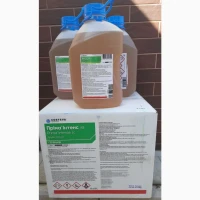
/ Fertilizers and plant protection products / Herbicides / Lumax is an excellent pre- and post-emergence herbicide...

For sale / buy
Lumaks - pre- and post-emergence excellent herbicide against weeds in corn crops and gardens, Kyiv region region.
Price7.75$
Region:all of Ukraine,
Kyiv region.
(Vyshhorodok)
Updated:
Herbicide Lumax - an excellent choice for pre- and post-emergence weed control.
Active substance content: S-metolachlor, 375 g/l + terbuthylazine, 125 g/l + mesotrione, 37.5 g/l
Preparative form: suspension emulsion
Mode of action: systemic (ground and insurance)
Consumption rate: 3.5-4.0 l/ha
Rate of consumption of working solution: 142
300-350 л/га
Packaging: 20 l, the price is for 1 l.
Registration certificate:
Advantages of Lumax Herbicide:
can be used as a soil and insurance herbicide at the same time (up to phase 5 leaves of corn);
control of common weed, ragweed and perennial dicotyledonous weeds (by vegetation);
can be used in unstable climatic conditions;
highly effective against weeds resistant to other drugs;
optimal for use by No-Till and Stripe-Till technologies;
the optimal choice when growing plots of hybridization of corn;
prolonged weed control (for 10 weeks).
Use of Lumax Herbicide:
Corn
Consumption rate - 3.5-4.0 l/ha
Spectrum of action - Annual cereals and dicotyledonous and some perennial dicotyledonous weeds(//tractor-service.com)
Time of application - Spraying before sowing, after sowing, on the steps (3-5 leaves per crop)
Number of treatments - 1
Apple tree, vineyards
Consumption rate - 3.5-4.0 l/ha
Spectrum of action - Annual cereals and dicotyledons and some perennial dicotyledonous weeds
Time of application - Spraying the soil before the appearance of weed seedlings or in the phases of 1-2 leaves in cereals and 2-4 leaves in dicotyledons.
Number of treatments - 1.
The mechanism of action of Lumax Herbicide:
Terbuthylazine affects the photosynthesis of plants, blocking the transport of electrons in weed cells, S-metolachlor affects the synthesis of proteins and fatty acids, which leads to the death of weeds. Mesotrione is an inhibitor of the biosynthesis of carotenoids, the violation of the protective screen of which leads to premature degradation of chlorophylls, discoloration and death of sensitive plants.
Recommendations for the use of Lumax Herbicide:
recommended consumption rate of the working solution: 300-350 l/ha;
Corn. With early postharvest application, the stage of development of one-year grass weeds should be 1-2 leaves, dicotyledons - 2-4 leaves. It is possible to apply on the ladder of culture. When applying to the soil in case of insufficient moisture, it is recommended to dig into the soil to a depth of 3-5 cm. If frosts are expected within 2-3 days, you should refrain from treating with the drug.
Apple tree, vineyards. Limit the exposure of the drug to the culture. Limit the use of the drug on irrigated light soils (due to possible washing of the active substance into the root zone).
Precautions for using Lumax Herbicide:
the use of the drug by aviation method is prohibited.
Proven tank mixtures of Lumax Herbicide:
In some cases (for example, in the garden) it can be used in mixtures with post-emergence herbicides (Reglon Super, Fusilade Forte).
It is not recommendedto use insecticides based on organophosphorus compounds and thiocarbamates 7 days before or after the application of Lumax herbicide, and also not to be used on corn crops whose seeds have been treated with insecticides based on organophosphorus compounds and thiocarbamates.
Crop rotation when using Lumax Herbicide:
If it is necessary to resow corn treated with Lumax herbicide (drought, frost, wetting),corn can be sown immediately. In the fall of the same year, you can sow winter barley and wheat, ryegrass, as well as winter rape if plowing has been done. Next spring, after plowing, you can sowsunflower, soybeans, sorghum, rapeseed, alfalfa. Sensitive crops, such as beets (sugar, table, fodder), peas, can be sown 18 months after using Lumax.
Active substance content: S-metolachlor, 375 g/l + terbuthylazine, 125 g/l + mesotrione, 37.5 g/l
Preparative form: suspension emulsion
Mode of action: systemic (ground and insurance)
Consumption rate: 3.5-4.0 l/ha
Rate of consumption of working solution: 142
300-350 л/га
Packaging: 20 l, the price is for 1 l.
Registration certificate:
Advantages of Lumax Herbicide:
can be used as a soil and insurance herbicide at the same time (up to phase 5 leaves of corn);
control of common weed, ragweed and perennial dicotyledonous weeds (by vegetation);
can be used in unstable climatic conditions;
highly effective against weeds resistant to other drugs;
optimal for use by No-Till and Stripe-Till technologies;
the optimal choice when growing plots of hybridization of corn;
prolonged weed control (for 10 weeks).
Use of Lumax Herbicide:
Corn
Consumption rate - 3.5-4.0 l/ha
Spectrum of action - Annual cereals and dicotyledonous and some perennial dicotyledonous weeds(//tractor-service.com)
Time of application - Spraying before sowing, after sowing, on the steps (3-5 leaves per crop)
Number of treatments - 1
Apple tree, vineyards
Consumption rate - 3.5-4.0 l/ha
Spectrum of action - Annual cereals and dicotyledons and some perennial dicotyledonous weeds
Time of application - Spraying the soil before the appearance of weed seedlings or in the phases of 1-2 leaves in cereals and 2-4 leaves in dicotyledons.
Number of treatments - 1.
The mechanism of action of Lumax Herbicide:
Terbuthylazine affects the photosynthesis of plants, blocking the transport of electrons in weed cells, S-metolachlor affects the synthesis of proteins and fatty acids, which leads to the death of weeds. Mesotrione is an inhibitor of the biosynthesis of carotenoids, the violation of the protective screen of which leads to premature degradation of chlorophylls, discoloration and death of sensitive plants.
Recommendations for the use of Lumax Herbicide:
recommended consumption rate of the working solution: 300-350 l/ha;
Corn. With early postharvest application, the stage of development of one-year grass weeds should be 1-2 leaves, dicotyledons - 2-4 leaves. It is possible to apply on the ladder of culture. When applying to the soil in case of insufficient moisture, it is recommended to dig into the soil to a depth of 3-5 cm. If frosts are expected within 2-3 days, you should refrain from treating with the drug.
Apple tree, vineyards. Limit the exposure of the drug to the culture. Limit the use of the drug on irrigated light soils (due to possible washing of the active substance into the root zone).
Precautions for using Lumax Herbicide:
the use of the drug by aviation method is prohibited.
Proven tank mixtures of Lumax Herbicide:
In some cases (for example, in the garden) it can be used in mixtures with post-emergence herbicides (Reglon Super, Fusilade Forte).
It is not recommendedto use insecticides based on organophosphorus compounds and thiocarbamates 7 days before or after the application of Lumax herbicide, and also not to be used on corn crops whose seeds have been treated with insecticides based on organophosphorus compounds and thiocarbamates.
Crop rotation when using Lumax Herbicide:
If it is necessary to resow corn treated with Lumax herbicide (drought, frost, wetting),corn can be sown immediately. In the fall of the same year, you can sow winter barley and wheat, ryegrass, as well as winter rape if plowing has been done. Next spring, after plowing, you can sowsunflower, soybeans, sorghum, rapeseed, alfalfa. Sensitive crops, such as beets (sugar, table, fodder), peas, can be sown 18 months after using Lumax.
|
Store, contacts | |
Yuriy / reviews, info. / evaluation activities | |
|
Phone:
+38(xxxxxx
show
| |
All user ads ~1000 | |
Ad ID: #1020442
(added by a registered user, registration date: 10-08-2016)
Added/Updated: 09-23-2026 09:17 (current, until: 09-23-2027)
Permanent Ad Address:
Impressions / views for today: ?, total: ?
Similar ads
There are many interesting ones among them...