/ Agricultural machinery, equipment, inventory / Post-harvest processing, storage (equipment) / Belt conveyors / Belt conveyor, belt conveyor


For sale / buy
Belt conveyor, belt conveyor, Kiev region.
Region:
Kiev region.
(Belaya Tserkov)
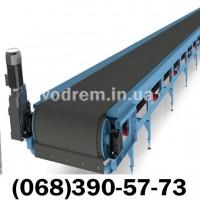
Belt conveyor (conveyor) - used for transportation loose, lumpy and artificial product. There are two types of belt conveyor - with a flat belt and with a belt in the form of a trough.
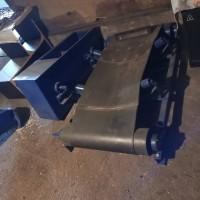
A belt conveyor with rollers or a floor (slats) that does not change the shape of the belt during transportation, leaving it flat - is used for transporting mostly artificial cargo, but with a side it can also transport bulk cargo and be used as a sorting table.
Belt conveyor conveyor - used for transporting bulk and lumpy cargo, sometimes pasty. The chute conveyor can form a chute with two or three rollers. Two-hitch chute conveyor - used for transporting light loads, or in areas with a small production capacity. Three-track chute conveyor with belt width from 600 mm. - used for transporting heavy loads or on conveyors with a large production capacity. In the belt conveyor, a belt with glued rubber or metal profile (combs) can be used to increase the angle of inclination of transportation and production capacity. Such conveyors are called comb conveyors. The comb conveyor is also used to transport such products as apples,potatoes,onions, pellets, etc.(//tractor-service.com)
We manufacture belt conveyors: with a cover - to protect cargo from precipitation and spraying; conveyor with height adjustment - used for the possibility of loading into containers of different heights; mobile conveyor, onwheels - used for the possibility of loading the product at several transshipment points; a conveyor with a reinforced joint, with a minimum number of support areas or heavy loads; conveyor with platforms for maintenance; conveyor with slug dischargers - for the possibility of unloading in several places; conveyor with unloading devices of various types; belt feeder.
We have produced more than 900 units of transport equipment.
We will manufacture a transporter according to the customer's needs, in a short time, with a guarantee, service and at an acceptable price. Shipping by our preferred carrier is possible. We will calculate the price of serial equipment in 5 - 30 minutes.
A belt conveyor with rollers or a floor (slats) that does not change the shape of the belt during transportation, leaving it flat - is used for transporting mostly artificial cargo, but with a side it can also transport bulk cargo and be used as a sorting table.
Belt conveyor conveyor - used for transporting bulk and lumpy cargo, sometimes pasty. The chute conveyor can form a chute with two or three rollers. Two-hitch chute conveyor - used for transporting light loads, or in areas with a small production capacity. Three-track chute conveyor with belt width from 600 mm. - used for transporting heavy loads or on conveyors with a large production capacity. In the belt conveyor, a belt with glued rubber or metal profile (combs) can be used to increase the angle of inclination of transportation and production capacity. Such conveyors are called comb conveyors. The comb conveyor is also used to transport such products as apples,potatoes,onions, pellets, etc.(//tractor-service.com)
We manufacture belt conveyors: with a cover - to protect cargo from precipitation and spraying; conveyor with height adjustment - used for the possibility of loading into containers of different heights; mobile conveyor, onwheels - used for the possibility of loading the product at several transshipment points; a conveyor with a reinforced joint, with a minimum number of support areas or heavy loads; conveyor with platforms for maintenance; conveyor with slug dischargers - for the possibility of unloading in several places; conveyor with unloading devices of various types; belt feeder.
We have produced more than 900 units of transport equipment.
We will manufacture a transporter according to the customer's needs, in a short time, with a guarantee, service and at an acceptable price. Shipping by our preferred carrier is possible. We will calculate the price of serial equipment in 5 - 30 minutes.
Ad ID: #490551
(added by an unregistered user)
Permanent ad address:
Showed / watched for today: ?, total: ?
Similar recent ads
Among them there are many interesting...



All Ukraine: Agricultural equipment, equipment, inventory 45625 / Post-harvest processing, storage (equipment) 1197 / Transporters lentochny 136
Kiev region: Agricultural equipment, equipment, inventory 4273 / Post-harvest processing, storage (equipment) 89 / Transporters ленточные 5