/ Fertilizers and plant protection products / Herbicides / Kratos (Harnes) - soil pre-emergence herbicide...
Buy / buy
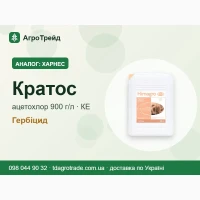
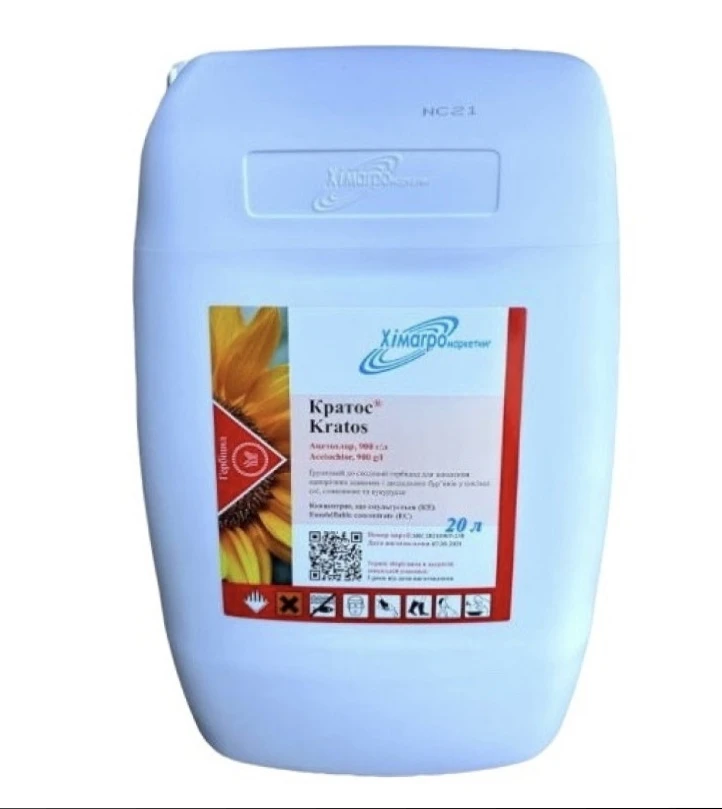
Kratos (Harnes) - soil pre-emergence herbicide against weeds in sunflower, soybean and other crops, Kyiv region region.
Price4500 UAH.
Region:all of Ukraine,
Kiev region.
(Vyshhorodok)
Updated:
Kratos (harness analogue) — soil preemergence herbicide for the control of annual grass and dicotyledonous weeds insunflower,corn, soybeans and other economically important crops.
The main characteristics of the herbicide:
Active substance Acetochlor, 900 g/l
The form of the preparation Emulsion concentrate (KE)
Object of action Annual cereals and some dicotyledonous weeds.
Culture Sunflower, corn, soybeans
Packaging 20l plastic canisters, the price is per canister.
Kratos application regulations:
Culture Target object Period of application of the drug Rate of consumption of the drug l/ha Rate of consumption of the working solution l/ha
Sunflower
Annual cereals and some dicotyledonous weeds
Spraying before sowing or 3-4 days before the appearance of sprouts.
1.5-2.7 l/ha
250-400 l/ha.
Corn
1.5-3.0 l/ha
Soy
1.5-2.2 l/ha
'(//tractor-service.com)
Benefits of using Herbicide Kratos:
Kratos creates better conditions for earlier crop growth by ensuring there is no competition with weeds.
The use of the drug makes it possible to sow crops earlier, which contributes to more effective use of winter and spring moisture by cultivated plants.
The use of a soil herbicide ensures the implementation of the "clean start" program, in which the culture receives an advantage - to use all vital factors of life support compared to weeds.
Economy - eliminates the need for inter-row tillage, which allows to reduce the costs of additional labor, fuel-lubricants and technical resources.
The half-life of the active substance over the course of 3 months allows the herbicide to be used in crop rotation, without restrictions.
How does the drug Kratos work?
The active substance, acetochlor, which is part of the herbicide, is absorbed from the soil mainly by the root system of weeds and through the leaf surface of seedlings. ⇒ Once inside the plant, the drug inhibits protein synthesis.
Action speed:
The effect of Kratos herbicide begins immediately after its introduction and continues throughout the growing season. The period of the protective effect of acetochlor lasts about 60 days (depending on the degree of moisture of the surface layer of the soil, the uniformity of the distribution of the working fluid, the time of emergence of crop seedlings.
What weeds does Kratos work on?
Highly sensitive and moderately sensitive: thistle, birch mustard, knotty mustard, renal mustard, Theophrastus's rope, mouse (species), pink thistle, chicken millet, field romance, chamomile (species), sundews (species), bulbous plantain, white sorrel, hybrid sorrel, common sorrel, lobodiform sorrel, the anchors are weak.
Weakly sensitive: ambrosia (species), field mustard, common dahlia, medium star, field chicken eyes, hybrid quinoa, milkweed-sunflower, netreba (species), tenacious nightshade, wild radish, medicinal turnip, white quinoa.
Instructions for using Kratos:
To achieve the highest efficiency, Kratos herbicide is recommended to be applied to leveled, moistened soil, on which there will be no harvest residues.
It is best to do this immediately after sowing the seeds or 3-4 days before the appearance of the first sprouts.
The herbicide cannot be used during heavy rains, as this can lead to the drug being washed into the seed zone.
The dosage of the drug is affected by the content of humus, the mechanical composition of the soil, and climatic conditions. The higher the soil moisture, the lower the consumption rate.
Disclaimer:
Attention! It is not allowed to apply to areas that have already been treated, as it can lead to the death of cultivated plants!
The main characteristics of the herbicide:
Active substance Acetochlor, 900 g/l
The form of the preparation Emulsion concentrate (KE)
Object of action Annual cereals and some dicotyledonous weeds.
Culture Sunflower, corn, soybeans
Packaging 20l plastic canisters, the price is per canister.
Kratos application regulations:
Culture Target object Period of application of the drug Rate of consumption of the drug l/ha Rate of consumption of the working solution l/ha
Sunflower
Annual cereals and some dicotyledonous weeds
Spraying before sowing or 3-4 days before the appearance of sprouts.
1.5-2.7 l/ha
250-400 l/ha.
Corn
1.5-3.0 l/ha
Soy
1.5-2.2 l/ha
'(//tractor-service.com)
Benefits of using Herbicide Kratos:
Kratos creates better conditions for earlier crop growth by ensuring there is no competition with weeds.
The use of the drug makes it possible to sow crops earlier, which contributes to more effective use of winter and spring moisture by cultivated plants.
The use of a soil herbicide ensures the implementation of the "clean start" program, in which the culture receives an advantage - to use all vital factors of life support compared to weeds.
Economy - eliminates the need for inter-row tillage, which allows to reduce the costs of additional labor, fuel-lubricants and technical resources.
The half-life of the active substance over the course of 3 months allows the herbicide to be used in crop rotation, without restrictions.
How does the drug Kratos work?
The active substance, acetochlor, which is part of the herbicide, is absorbed from the soil mainly by the root system of weeds and through the leaf surface of seedlings. ⇒ Once inside the plant, the drug inhibits protein synthesis.
Action speed:
The effect of Kratos herbicide begins immediately after its introduction and continues throughout the growing season. The period of the protective effect of acetochlor lasts about 60 days (depending on the degree of moisture of the surface layer of the soil, the uniformity of the distribution of the working fluid, the time of emergence of crop seedlings.
What weeds does Kratos work on?
Highly sensitive and moderately sensitive: thistle, birch mustard, knotty mustard, renal mustard, Theophrastus's rope, mouse (species), pink thistle, chicken millet, field romance, chamomile (species), sundews (species), bulbous plantain, white sorrel, hybrid sorrel, common sorrel, lobodiform sorrel, the anchors are weak.
Weakly sensitive: ambrosia (species), field mustard, common dahlia, medium star, field chicken eyes, hybrid quinoa, milkweed-sunflower, netreba (species), tenacious nightshade, wild radish, medicinal turnip, white quinoa.
Instructions for using Kratos:
To achieve the highest efficiency, Kratos herbicide is recommended to be applied to leveled, moistened soil, on which there will be no harvest residues.
It is best to do this immediately after sowing the seeds or 3-4 days before the appearance of the first sprouts.
The herbicide cannot be used during heavy rains, as this can lead to the drug being washed into the seed zone.
The dosage of the drug is affected by the content of humus, the mechanical composition of the soil, and climatic conditions. The higher the soil moisture, the lower the consumption rate.
Disclaimer:
Attention! It is not allowed to apply to areas that have already been treated, as it can lead to the death of cultivated plants!
|
Shop, contacts | |
Yuriy / отзывы, инфо. / оценка activities | |
|
Telephone:
+38(xxxxxx
show
| |
All user ads ~1000 | |
Ad ID: #1139456
(added by a registered user, registration date: 10-08-2016)
Added / Updated: 09-23-2026 09:20 (relevant, until: 09-23-2027)
Permanent ad address:
Showed / watched for today: ?, total: ?
Similar ads
Among them there are many interesting ones...